Blog
What Is a Golden Rectangle?
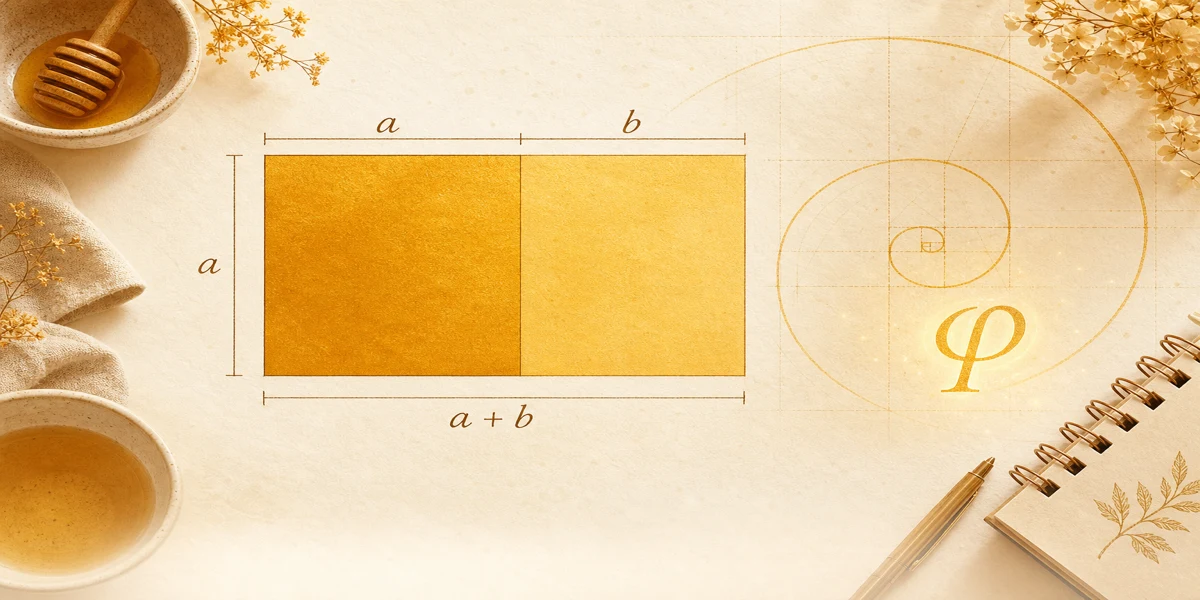
Learn what a golden rectangle is, how side labels a and b fit the square-plus-strip diagram, and why φ appears in art, design, and geometry class.
By Golden Rectangle Calculator Team

Blog
Learn what a golden rectangle is, how side labels a and b fit the square-plus-strip diagram, and why φ appears in art, design, and geometry class.
By Golden Rectangle Calculator Team
A golden rectangle satisfies (a + b) ÷ a = a ÷ b = φ (φ ≈ 1.618). Use the Golden Rectangle Calculator to enter square side a or strip width b.
Formula
The Golden Rectangle Calculator labels a and b the same way your textbook sketch does: a on the square, b on the strip beside it. This article defines the shape before you crunch numbers.
Students often meet golden rectangles through the golden ratio φ. The rectangle is the geometric picture; φ is the number that ties the sides together.
Whether you work in pixels, centimeters, or inches, the definition does not change. Only the unit on a and b changes.
After you understand the labels, you can verify any drawing with two quick division checks.
Start with an a × a square on the left. Add a companion piece on the right with the same height a and width b. The outer boundary is a rectangle of height a and total width a + b.
The shape is golden when the ratio of total width to height equals the ratio of height to strip width. Both ratios equal φ, approximately 1.618.
If you remove the square, the leftover piece is similar to the full rectangle. That self-similarity is why golden rectangles show up in spirals, grid systems, and repeated layout modules. For symbol rules and rearranged forms, see the golden rectangle formula guide.
In architecture and design, golden rectangles are a proportion tool, not a magic aesthetic law. They give you a repeatable width-to-height target that many people find calm compared with extreme wide or tall boxes.
Photography and print layouts sometimes approximate golden proportions. A true golden frame from height a uses total width a + b = a × φ, which is slightly wider than common 3:2 crop ratios.
The two ratio tests say the same thing for positive lengths. If (a + b) ÷ a equals φ, then a ÷ b will also equal φ when labels match the diagram on this site.
Once you trust the definition, move to numeric work in the step-by-step calculation guide. There you can solve for b from a, or a from b, then compute area without guessing.
Designers often remember total width ≈ 1.618 × height when height is a. That is the same as a + b = a × φ.
Use the full outline measurements. Do not divide by b alone when you need total width.
Suppose the square side is a = 8 cm. Strip width is b = 8 ÷ φ ≈ 4.94 cm. Total width is a + b ≈ 12.94 cm.
Check ratios: 12.94 ÷ 8 ≈ 1.618 and 8 ÷ 4.94 ≈ 1.618. Area = 8 × 12.94 ≈ 103.5 cm².
Open the calculator on the home page, enter a = 8, and confirm b, a + b, and area match these values.
If your measured ratios drift far from 1.618, relabel sides or remeasure before calling the figure golden.
A golden rectangle is defined by equal ratio checks on total width, height, and strip width, with a on the square and b on the strip.
Keep φ handy for mental estimates, but use exact division for homework, CAD, or CSS math.
When you are ready for numbers, use the home tool or follow the formula and calculation articles linked above.
Golden rectangle and Fibonacci sequence: how ratios approach φ, exact side math vs integer pairs, and checks with our free calculator.
Golden rectangle in design for web layout, logos, UI, and photography. Set width a + b from height a using φ and the free calculator.
Golden rectangle vs golden ratio: how φ differs from labeled sides, when to use each idea, and ties to the free dimension calculator.