Blog
Golden Rectangle and Fibonacci Sequence
Connect Fibonacci numbers, their ratio limit φ, and golden rectangle side math for class projects and spiral illustrations.
By Golden Rectangle Calculator Team

Blog
Connect Fibonacci numbers, their ratio limit φ, and golden rectangle side math for class projects and spiral illustrations.
By Golden Rectangle Calculator Team
F(n+1)/F(n) → φ. Exact golden sides use the Golden Rectangle Calculator with φ, not Fibonacci integers alone.
Formula
The Fibonacci story and the Golden Rectangle Calculator share φ but not the same arithmetic path. This article separates limit ideas from exact side formulas.
Spiral posters often tile squares with Fibonacci edge lengths. Those squares approximate golden rectangles; they are not exact unless you force φ.
Homework may ask for the limit proof and a numeric rectangle in the same unit test.
Use Fibonacci for intuition and φ for engineering or pixel-perfect layout.
Divide consecutive Fibonacci terms: 8/5, 13/8, 21/13, each hopping closer to φ.
The limit explains why nature diagrams and textbooks mention both rabbits and golden rectangles in one chapter.
Exact classroom rectangles should still use b = a ÷ φ from the {{linkB}}, especially when grading checks two ratio decimals.
For φ definition and verification language, see {{linkA}}.
A rectangle with sides 8 and 13 has ratio 1.625, slightly above φ. With a = 8, exact golden b ≈ 4.94, not 5.
Spiral constructions quarter circles inside shrinking squares; side lengths often follow Fibonacci numbers for easy counting.
When a project needs exact φ, switch from integers to the calculator rather than the nearest Fibonacci pair.
Works on one worksheet with calculator checks.
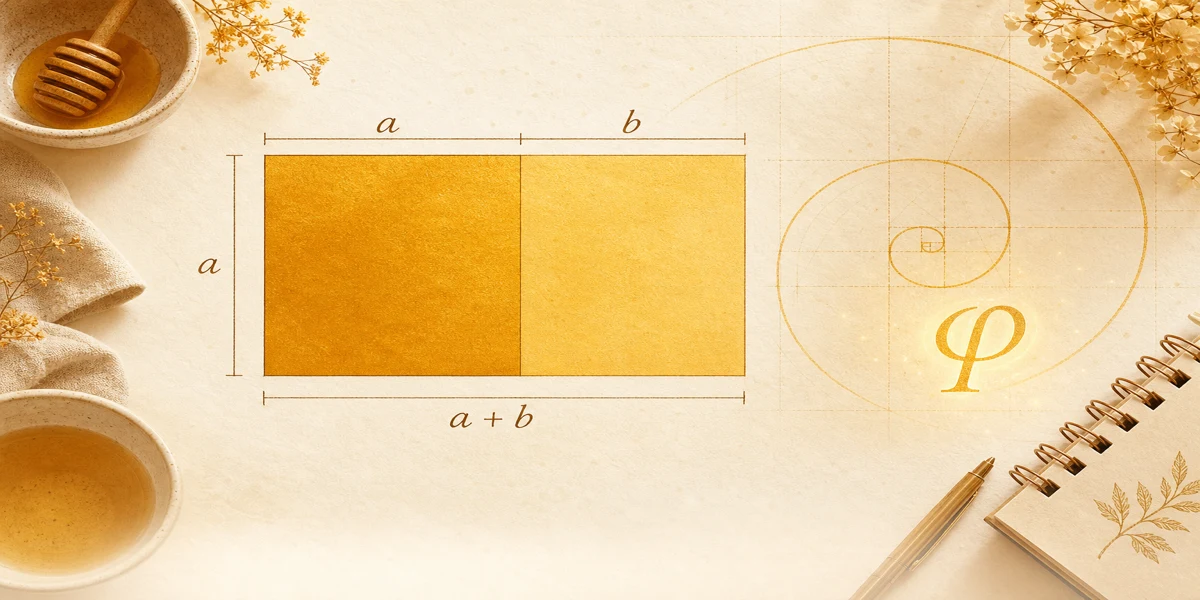
Exact golden: a = 8, b = 8 ÷ φ ≈ 4.94 cm, total width ≈ 12.94 cm.
Fibonacci neighbor story: 8 and 5 give width 13 if you treat them as square plus strip, but 13/8 = 1.625, not φ.
Enter a = 8 in the calculator and compare to a hand-drawn 8 by 5 sketch.
Discuss error size: 1.625 versus 1.618 matters on large banners, less on tiny icons.
Fibonacci ratios explain where φ comes from; golden rectangle formulas use φ directly on labeled sides.
Approximate spirals teach patterns; exact tools teach design-grade math.
Return to the home calculator whenever integers are not close enough.
Golden rectangle in design for web layout, logos, UI, and photography. Set width a + b from height a using φ and the free calculator.
Golden rectangle vs golden ratio: how φ differs from labeled sides, when to use each idea, and ties to the free dimension calculator.
Golden rectangle construction with compass and straightedge. Link classical steps to a, b, and φ, then check values on the free calculator.