Blog
Golden Rectangle Examples
Concrete golden rectangle examples for math class, layout design, architecture sketches, and photography frames, with numbers tied to φ.
By Golden Rectangle Calculator Team

Blog
Concrete golden rectangle examples for math class, layout design, architecture sketches, and photography frames, with numbers tied to φ.
By Golden Rectangle Calculator Team
Examples below use φ ≈ 1.618. Confirm any row on the Golden Rectangle Calculator.
Formula
This article turns abstract φ into numbers you can sketch, code, or measure. Use the Golden Rectangle Calculator to confirm each row.
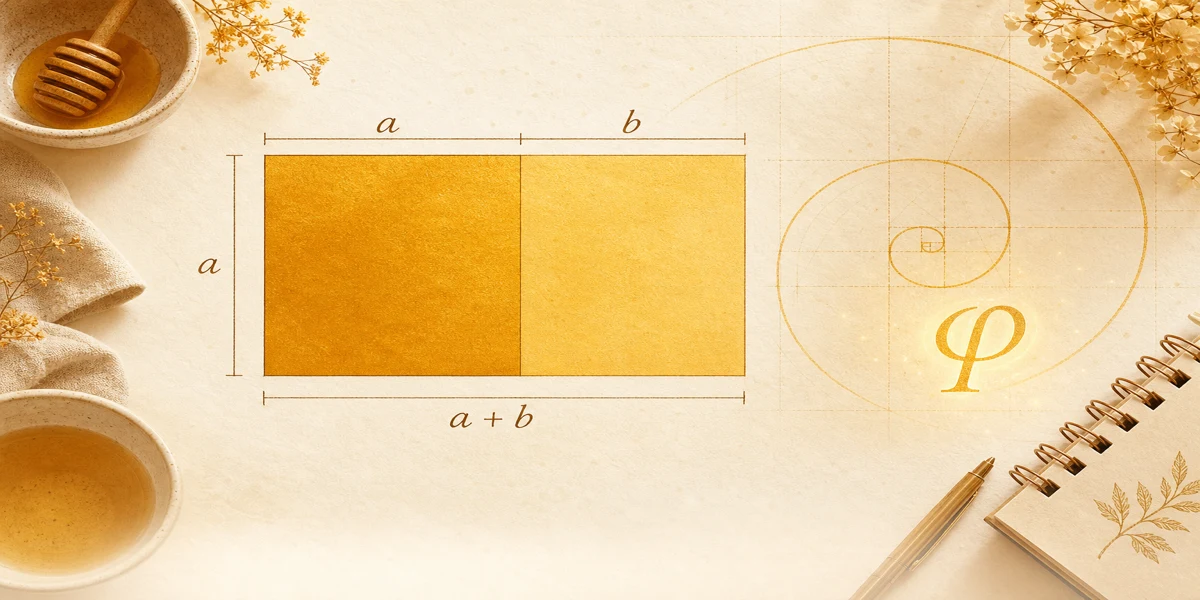
Examples share the site labeling: a is square side and height, b is strip width, total width is a + b.
Approximate ratios like 3:2 or 16:9 are not automatically golden. Measure (a + b) ÷ a when precision matters.
Pick one unit per example and keep it through area so units stay consistent.
Unit square a = 1 gives b = 1 ÷ φ ≈ 0.618 and total width ≈ 1.618. Area ≈ 1.618 square units, a neat numeric rhyme for slides.
a = 5 units yields b ≈ 3.09, total width ≈ 8.09, area ≈ 40.45. These match the worked problems in the formula sheet.
a = 13 cm (a Fibonacci number) does not automatically pair with 8 cm as an exact golden strip; use b = 13 ÷ φ for exact φ, or treat 8 and 13 as an approximation exercise.
On graph paper, draw the square first, mark b to the right, then outline the full width before checking ratios.
UI module: a = 960 px height gives total width ≈ 1552 px. Useful for hero sections that should feel wider than square but not cinematic 21:9.
Facade sketch: a = 3 m height implies total width about 4.85 m. Always check local codes before building from proportion alone.
Photography mat: inner opening height a = 280 mm suggests golden outer width about 453 mm. Compare with print shop standard sizes before ordering.
For composition tips inside those frames, see {{linkB}}.
Repeat any row with your own unit.
Height a = 400 px for a web banner gives golden total width about 647 px. A 3:2 box at height 400 would be 600 px wide, noticeably narrower.
Credit cards and phones are often near convenient ratios, not exact φ. Measure before calling them golden in a paper.
Paste a = 400 into the calculator and compare to your habitual 3:2 template.
When teaching, contrast golden width with rule-of-thirds overlays so students see different guides.
Examples connect φ to measurable width, height, and area.
Always label a and b before comparing to a photo or building photo.
Use the calculator to generate fresh numbers for worksheets.
Golden rectangle and Fibonacci sequence: how ratios approach φ, exact side math vs integer pairs, and checks with our free calculator.
Golden rectangle in design for web layout, logos, UI, and photography. Set width a + b from height a using φ and the free calculator.
Golden rectangle vs golden ratio: how φ differs from labeled sides, when to use each idea, and ties to the free dimension calculator.