Blog
Golden Rectangle Construction
Construct a golden rectangle with classical tools, read the square-plus-strip result, and connect construction marks to calculator inputs.
By Golden Rectangle Calculator Team

Blog
Construct a golden rectangle with classical tools, read the square-plus-strip result, and connect construction marks to calculator inputs.
By Golden Rectangle Calculator Team
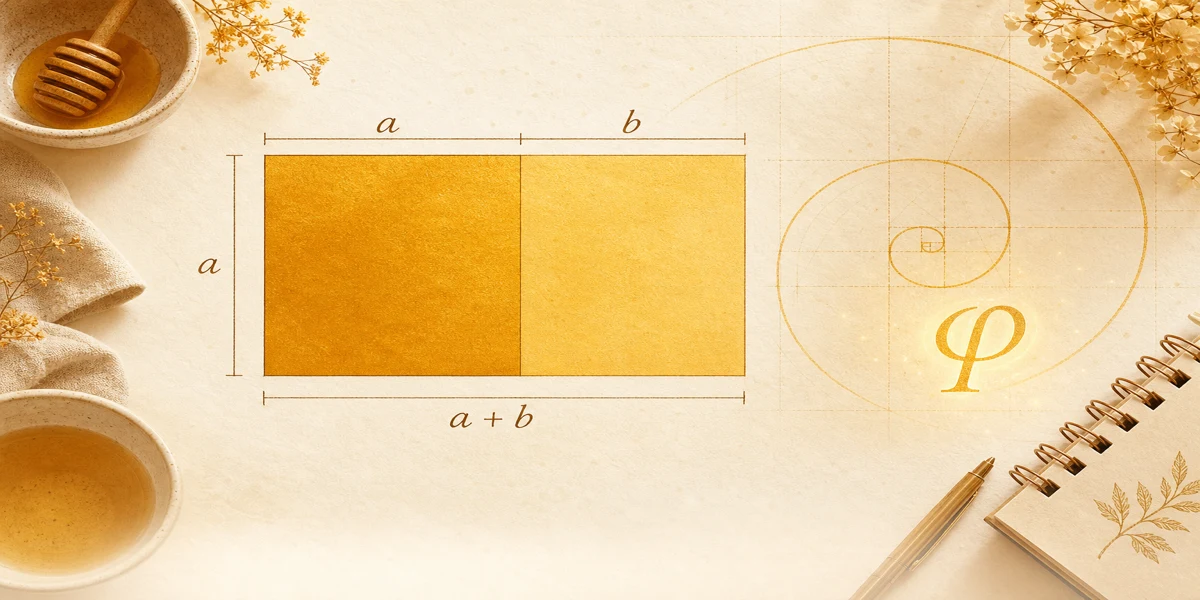
Construction yields height a and width about a × φ. Strip width is b = a ÷ φ. Check on the Golden Rectangle Calculator.
Formula
This article links compass-and-straightedge sketches to the Golden Rectangle Calculator so classroom drawing matches browser results.
Construction proofs show why φ appears on the base line, not just on a worksheet.
Different textbooks use slightly different arc steps, but the goal is always width-to-height equal to φ.
After drawing, measure your paper figure and compare ratios before claiming exact golden status.
Begin with square ABCD of side a. The square fixes height and the left portion of total width.
Classical methods extend the base using √5 geometry so the full width becomes φ times a.
The segment beside the square is width b. Numeric value comes from {{linkA}} once you know a.
Our {{linkB}} explains the same labels students see on the finished sketch.
If your construction ends with total width 16.18 cm and height 10 cm, then (a + b) ÷ a ≈ 1.618 with a = 10.
Strip width is total width minus a. That difference should match b from b = a ÷ φ.
Area of the completed outline is a × (a + b), the same as the calculator area field.
Adapt arc details to your curriculum; keep the goal width-to-height = φ.
Paper square side a = 6 cm. Measured total width 9.7 cm gives ratio 9.7 ÷ 6 ≈ 1.617, close to φ with drawing error.
Expected b = 6 ÷ φ ≈ 3.71 cm. Measured strip near 3.7 cm supports the construction.
Enter a = 6 in the calculator for exact values to compare with pencil tolerance.
Scan or photograph student work and discuss measurement error versus math error.
Construction connects φ on paper to a and b in formulas.
Measure after drawing; do not assume perfection without ratio checks.
Use the calculator to show exact targets beside hand-drawn results.
Golden rectangle and Fibonacci sequence: how ratios approach φ, exact side math vs integer pairs, and checks with our free calculator.
Golden rectangle in design for web layout, logos, UI, and photography. Set width a + b from height a using φ and the free calculator.
Golden rectangle vs golden ratio: how φ differs from labeled sides, when to use each idea, and ties to the free dimension calculator.